If US/ British policy in Iraq had been guided by the gambling instincts of the American and British people, who did not think the war was worth the risk, rather than the gambling instincts of Bush and Blair who did think it was worth the risk, what then?
What Blair and Bush did, apart from kneeling down to pray together like a pair of Mullahs,
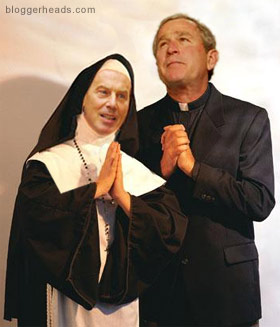
what if they had not relied on 'filtering expert' opinion in order to prioritise their 'elite' judgement.
Were they aware as they knelt together that when decision-making devolves onto a small group of self-consciously well-informed individuals, it is all too likely that they will lead each other astray, trusting too much in their own judgment and reinforcing each other’s prejudices.
Tony Blair went to war in the face of widespread (though by no means universal) public scepticism. He justified this course of action on two grounds. First, it was his job to take a lead, even if the public did not like it. The implication here was that the public were against the war because, perfectly understandably, most people prefer not to go to war; but democratic politicians cannot always be guided by popular preferences. The second justification was that Blair, and his security services, knew more about the nature of the threat posed by Saddam than the general public, because they had access to much more information. It now turns out that this information was wrong.
It is also true that different people opposed the war for all sorts of different reasons, many of them pretty unconvincing in their own terms (Saddam’s not that bad, we sold him most of his weapons, if Blair’s for it I’m against it, George Bush is an idiot, do you know those two pray together etc). But it is this very diversity of opinion that may explain why the public had a better overall idea of what was going on than those in the closed, secretive, hothouse worlds of Downing Street (and Washington).
Nevertheless, Blair can argue, no one knew any better at the time, But maybe the public did know better at the time. Perhaps the ignorant masses were actually better equipped to assess the nature of the risk than the experts,
What if the ignorance of the masses turns out to be not a weakness but a strength?
.
What Blair and Bush did, apart from kneeling down to pray together like a pair of Mullahs,
what if they had not relied on 'filtering expert' opinion in order to prioritise their 'elite' judgement.
Were they aware as they knelt together that when decision-making devolves onto a small group of self-consciously well-informed individuals, it is all too likely that they will lead each other astray, trusting too much in their own judgment and reinforcing each other’s prejudices.
Tony Blair went to war in the face of widespread (though by no means universal) public scepticism. He justified this course of action on two grounds. First, it was his job to take a lead, even if the public did not like it. The implication here was that the public were against the war because, perfectly understandably, most people prefer not to go to war; but democratic politicians cannot always be guided by popular preferences. The second justification was that Blair, and his security services, knew more about the nature of the threat posed by Saddam than the general public, because they had access to much more information. It now turns out that this information was wrong.
It is also true that different people opposed the war for all sorts of different reasons, many of them pretty unconvincing in their own terms (Saddam’s not that bad, we sold him most of his weapons, if Blair’s for it I’m against it, George Bush is an idiot, do you know those two pray together etc). But it is this very diversity of opinion that may explain why the public had a better overall idea of what was going on than those in the closed, secretive, hothouse worlds of Downing Street (and Washington).
Nevertheless, Blair can argue, no one knew any better at the time, But maybe the public did know better at the time. Perhaps the ignorant masses were actually better equipped to assess the nature of the risk than the experts,
What if the ignorance of the masses turns out to be not a weakness but a strength?
.

No comments:
Post a Comment